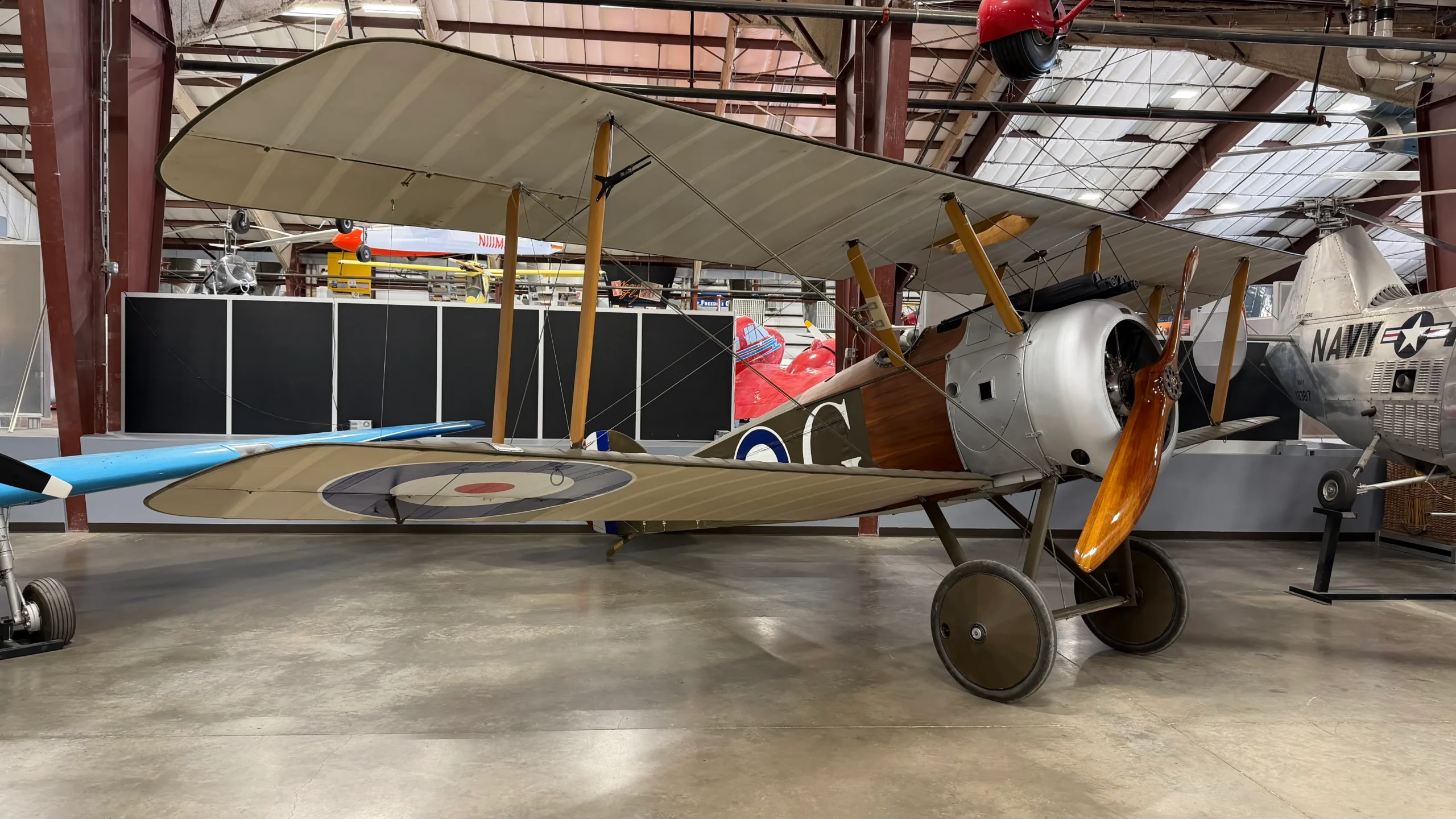
The Sopwith Camel is a British First World War single-seat biplane fighter aircraft that was introduced on the Western Front in 1917. It was developed by the Sopwith Aviation Company as a successor to the Sopwith Pup and became one of the best-known fighter aircraft of the Great War. By war’s end, approximately 5,490 were manufactured. Pilots flying Camels were credited with downing 1,294 enemy aircraft, more than any other Allied fighter of the conflict. Towards the end of the war, Camels lost their edge as fighters and were also used as ground-attack aircraft.
The main variant of the Camel was designated as the F.1. Other variants included the 2F.1 Ship’s Camel, which operated from aircraft carriers; the Comic night fighter variant; and the T.F.1, a “trench fighter” armored for attacks on heavily defended ground targets. A two-seat variant served as a trainer. In the aftermath of the First World War, the Camel saw further combat action. Multiple British squadrons were deployed into Russia as part of the Allied intervention in the Russian Civil War. The last Camels were withdrawn from RAF service in January 1920.
This Sopwith Camel F.1 was one of two faithfully built from original drawings by Englishman John Shaw. Camel F1 F-AZZC was damaged during its maiden flight the damage to the aircraft was extensive, and finishing his second project would be faster and cheaper than repairing the crashed aircraft. The museum acquired the project from Shaw in 2018 and has been slowly restoring it over the past several years.
The Camel is painted to represent one flown by WW I Ace pilot Lt. Alfred John Haines of the Royal Flying Corps. Assigned to No. 45 Squadron in Italy; Haines was credited with destroying six enemy aircraft. He was killed in action on 10 August 1918, when he took a direct hit from anti-aircraft fire while dropping propaganda leaflets over the front lines.
Wingspan | |
Length | |
Height | |
Weight | |
Maximum Speed | |
Service Ceiling | |
Range | |
Engines | |
Crew |